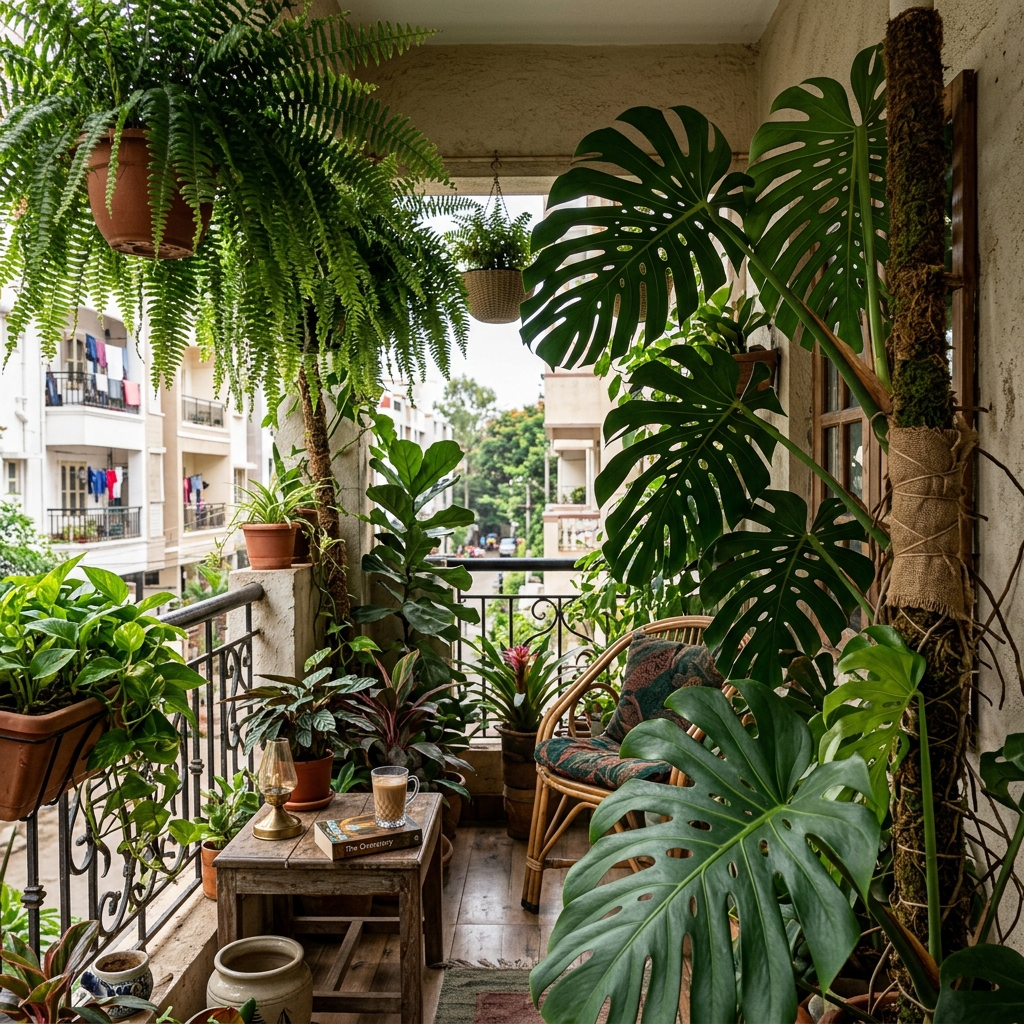
The Urban Jungle Dream
Living in a high-rise concrete jungle doesn't mean you can't have your own slice of a tropical rainforest. If you have a balcony that receives primarily indirect light or heavy shade, you are in the perfect position to cultivate a breathtaking, lush urban jungle. By relying on the dramatic foliage of aroids (like Monsteras and Philodendrons) paired with the delicate texture of ferns, you can create a cool, relaxing oasis that defies the urban sprawl outside. Here is your 800-word blueprint to building a tropical balcony in India.
Understanding the Shade Canopy
The plants that make up a tropical jungle floor have evolved under the dense canopy of massive trees. They are accustomed to low light, high humidity, and soil rich in decaying organic matter. They absolutely despise direct, harsh sunlight, which will bleach and scorch their broad leaves. If your balcony gets only 1-2 hours of gentle morning sun and bright shade for the rest of the day, it is prime real estate for a tropical theme.
The Stars of the Show: Aroids
To create impact, you need structural, large-leaved plants. The Monstera deliciosa (Swiss Cheese Plant) is the undisputed king of the urban jungle. Its massive, deeply fenestrated (split) leaves give instant tropical vibes. Pair it with climbing Philodendrons (like the Heartleaf or the majestic Philodendron Selloum) and vibrant Syngoniums.
These plants are natural climbers. In the wild, they grow up the trunks of massive trees. To get large, mature leaves on your balcony, you must provide them with a support structure to climb. A thick moss pole or coco-coir pole is essential. As the plant’s aerial roots grip the pole, the plant feels secure, and in response, it will start producing significantly larger leaves with more complex fenestrations.
The Understory: Ferns and Calatheas
Beneath the towering Monsteras, you need lush, dense ground cover to complete the jungle look. Ferns are perfect for this. The Boston Fern, with its arching, feathery fronds, looks incredible in hanging baskets, creating a cascading curtain of green. For the lower pots, the Bird’s Nest Fern provides a structural, rippled rosette of bright green leaves.
For pops of color without relying on flowers, introduce Calatheas and Marantas (Prayer Plants). Their leaves feature intricate, hand-painted patterns of pink, purple, and silver. However, be warned: they are notorious "divas" regarding humidity.
Mastering the Jungle Soil Mix
Tropical aroids need an "Aroid Mix"—soil that is chunky, airy, and rich in organic matter. A standard heavy garden soil will suffocate their roots. Mix equal parts of cocopeat (for moisture retention), perlite or pumice (for aeration), pine bark chunks (for structure and airflow), and high-quality vermicompost (for nutrients).
For ferns, tweak the mix to hold slightly more moisture by increasing the cocopeat ratio. Ferns do not want to dry out completely, while Monsteras prefer the top two inches of soil to dry before the next watering.
The Battle for Humidity
The biggest challenge in maintaining a tropical balcony in an Indian city (especially during the dry winters or scorching summers) is humidity. These plants thrive in 60-80% ambient humidity. When the air is too dry, fern fronds will turn brown and crisp at the edges, and Monstera leaves may struggle to unfurl, tearing in the process.
Misting with a spray bottle is a common practice, but its effects last only for a few minutes. To truly raise humidity, group your plants closely together. As they transpire (sweat), they create a localized micro-climate of higher humidity. You can also place pebble trays filled with water beneath the pots; as the water evaporates, it surrounds the foliage with moisture. If your balcony is enclosed, running a small humidifier is the ultimate solution.
Feeding the Jungle
Because you are pushing a lot of rapid foliage growth, your tropical plants will need regular feeding during the warm months. Use a balanced, water-soluble organic fertilizer every two weeks. Seaweed extract is highly recommended as a foliar spray; it acts as a stress-reliever and promotes lush, dark green foliage.
Conclusion
Creating a tropical balcony is a lesson in micro-climate management. By combining the dramatic, climbing architecture of Monsteras with the soft, cascading textures of ferns, providing a chunky, airy soil mix, and ruthlessly maintaining high humidity, you can successfully recreate the lush serenity of a rainforest right outside your apartment doors.